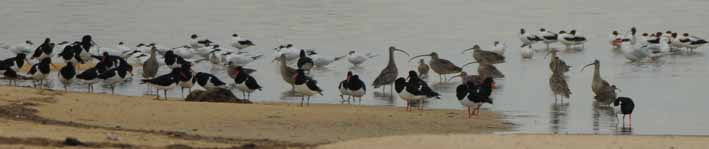
Stockyard Point: Australian pied oystercatchers, gull-billed terns, whimbrels, eastern curlews, red-necked avocets, Caspian terns, silver gulls. Photos: Jack Airey
By Jack Airey
Jam Jerrup to Stockyard Point
ON A cool, overcast and windy morning in January, 27 members of the Ringwood Field Naturalists Club and two guests from the Peninsula Field Naturalists Club met at Jam Jerrup for an excursion to Stockyard Point, identified by BirdLife Australia as an important bird area in Western Port.
Western Port is the summer home to large numbers of international migratory shorebirds – birds that breed in Siberia and Alaska during the northern hemisphere summer and migrate south to Australia for our summer.
While in Australia, the birds spend most of their time living on intertidal mudflats and the edges of shallow bodies of water, hence the name shorebirds, feeding on the invertebrates, molluscs, gastropods and small crustaceans that inhabit these areas. Birdwatchers in Australia will regularly travel to good “shorebird sites” during the summer months to observe these beautiful and amazing birds.
Jam Jerrup to Stockyard Point
ON A cool, overcast and windy morning in January, 27 members of the Ringwood Field Naturalists Club and two guests from the Peninsula Field Naturalists Club met at Jam Jerrup for an excursion to Stockyard Point, identified by BirdLife Australia as an important bird area in Western Port.
Western Port is the summer home to large numbers of international migratory shorebirds – birds that breed in Siberia and Alaska during the northern hemisphere summer and migrate south to Australia for our summer.
While in Australia, the birds spend most of their time living on intertidal mudflats and the edges of shallow bodies of water, hence the name shorebirds, feeding on the invertebrates, molluscs, gastropods and small crustaceans that inhabit these areas. Birdwatchers in Australia will regularly travel to good “shorebird sites” during the summer months to observe these beautiful and amazing birds.
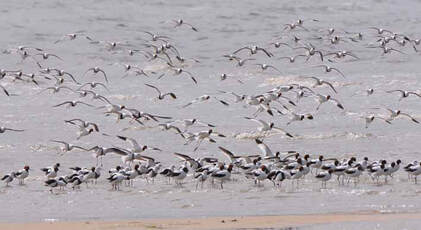 Red-necked avocets and banded stilts. Photo: Jack Airey
 Migratory shorebirds seen regularly at Stockyard Point range from the tiny red-necked stint (14 centimetres, 25 grams) to the largest shorebird in the world, the eastern curlew (63 centimetres, 900 grams). Stockyard Point is also a high-tide roost for Australian shorebirds, birds that live and breed in Australia. It even hosts a shorebird, the double-banded plover, which migrates to Australia from New Zealand in winter.
From the carpark we headed onto the beach for the 30-minute walk to the point. We arrived at the point at high tide – this is the best time to look for shorebirds as they are concentrated high on the beach. A lot of shorebirds congregate at Stockyard Point at high tide when other low-lying areas of Western Port are inundated.
Rounding the point we were very excited to find a large flock of shorebirds and out came the scopes and binoculars to identify the species. Oddly there were no international shorebirds in the flock but there were excellent numbers of three Australian shorebirds: the red-necked avocet, banded stilt and pied oystercatcher. There were also Caspian terns and gull-billed terns among the silver gulls.
The total number of bird species seen for the day was 36.
We spent an hour or so at the point discussing the birds we saw and the plants, as well as sand wasps that were excavating burrows among the bushes.
With the wind and rain closing in, we headed back to the carpark for our lunch. The clouds parted and the sun came out to warm us all up. No sooner had we finished lunch though, the clouds shrouded the sun and the wind picked up so we called it a day.
From the carpark we headed onto the beach for the 30-minute walk to the point. We arrived at the point at high tide – this is the best time to look for shorebirds as they are concentrated high on the beach. A lot of shorebirds congregate at Stockyard Point at high tide when other low-lying areas of Western Port are inundated.
Rounding the point we were very excited to find a large flock of shorebirds and out came the scopes and binoculars to identify the species. Oddly there were no international shorebirds in the flock but there were excellent numbers of three Australian shorebirds: the red-necked avocet, banded stilt and pied oystercatcher. There were also Caspian terns and gull-billed terns among the silver gulls.
The total number of bird species seen for the day was 36.
We spent an hour or so at the point discussing the birds we saw and the plants, as well as sand wasps that were excavating burrows among the bushes.
With the wind and rain closing in, we headed back to the carpark for our lunch. The clouds parted and the sun came out to warm us all up. No sooner had we finished lunch though, the clouds shrouded the sun and the wind picked up so we called it a day.